Insight
Agent First: Why Your Website Must Now Work for Humans and Machines
Your next customer may never visit your website. Their AI agent will. What sounds like a vision of the future is already statistical reality: since 2024, machines have generated more web traffic than humans. And a growing share of those machines no longer read for a search index, but on behalf of a person – to answer questions, compare providers and prepare decisions.
Agent first means websites must now work for two audiences – for people who read and click, and for AI systems that extract, compare and act on behalf of a user. Using data from Cloudflare, Imperva, Pew Research, Ahrefs, Adobe and the Swiss Federal Statistical Office, this article shows how far that shift has come, what stands out in Switzerland – and what businesses can concretely do now.
More Than Half of the Internet Is No Longer Human
According to the Imperva Bad Bot Report 2026 (April 2026), bots generated around 53 % of all web traffic in 2025, with humans down to 47 %. In 2024 the automated share was 51 % – the first year machines held the majority. Cloudflare, whose network carries a substantial share of global web traffic, confirmed in July 2026: more than 50 % of internet traffic is now non-human.
An important caveat: those 53 % are not “AI agents”. They include search engine crawlers, monitoring tools, scrapers, security bots – and a growing share of AI crawlers. But the direction is unambiguous. Network provider Fastly measured in June 2026 that AI-related traffic grew by around 30 % between January and May 2026 – 6.5 times faster than human traffic. Autonomous machine-to-machine traffic, according to Fastly, is approaching half of all internet requests.
The sentence to remember: your website already has more machine visitors than human ones. The only question is what those machines find there.
Index, Read, Answer, Act: Four Kinds of Machine Visit
Not every bot is the same. It pays to sort machine traffic by what the machine does with your content. Since July 2026, Cloudflare officially distinguishes three crawler categories – Search, Training and Agent. We add a fourth stage that sits between answer and action:
- Index. The classic search engine crawler. According to Cloudflare Radar, Googlebot alone accounted for 4.5 % of all HTML requests in 2025 – all AI bots combined already reached 4.2 %.
- Read (training). GPTBot, ClaudeBot and others collect content to train models. In June 2026, 52 % of all crawler requests were for AI training according to Cloudflare – up from 22 % in spring 2025. GPTBot climbed from rank 9 to rank 3 of the most active crawlers between May 2024 and May 2025 (+305 %).
- Answer (real-time retrieval). When ChatGPT, Perplexity or Google AI Mode fetch pages live for a specific user question. This category is still small but growing fastest: Cloudflare measured a more than 15× increase in so-called user-action crawling in 2025; the ChatGPT-User bot grew 2,825 % within a year. TollBit observed between Q1 and Q4 2025 that real-time retrieval (RAG) rose 33 % while pure training scrapes fell 15 % – and that there was already one AI bot visit for every 31 human visits (early 2025: one in 200).
- Act (agent). The agent does not just read – it navigates, filters, compares and performs actions. This stage is still the smallest today – and the one that will change the web the most.
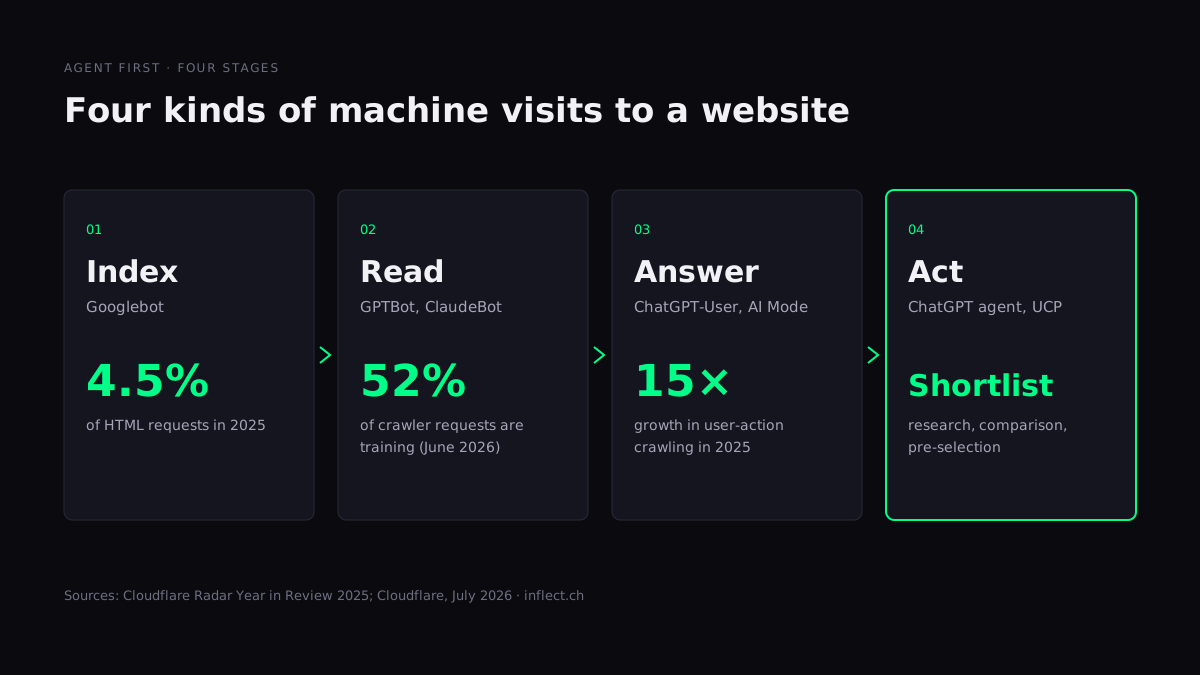
The shift from stage 2 to stage 3 is the decisive trend: machines increasingly fetch your content not in advance, but at the moment of a specific question – for a specific person.
Machines Read, but They Don’t Click
This is the real break with the old logic. A search engine crawler was a fair deal: Google reads your page and sends you visitors in return. With AI systems, that ratio is extremely one-sided. In August 2025 Cloudflare published the so-called crawl-to-click ratio – how many pages a provider fetches per visitor it sends back:
- Google: 5.4 pages per referred visit
- Perplexity: 194 to 1
- OpenAI: 1,091 to 1
- Anthropic: 38,065 to 1
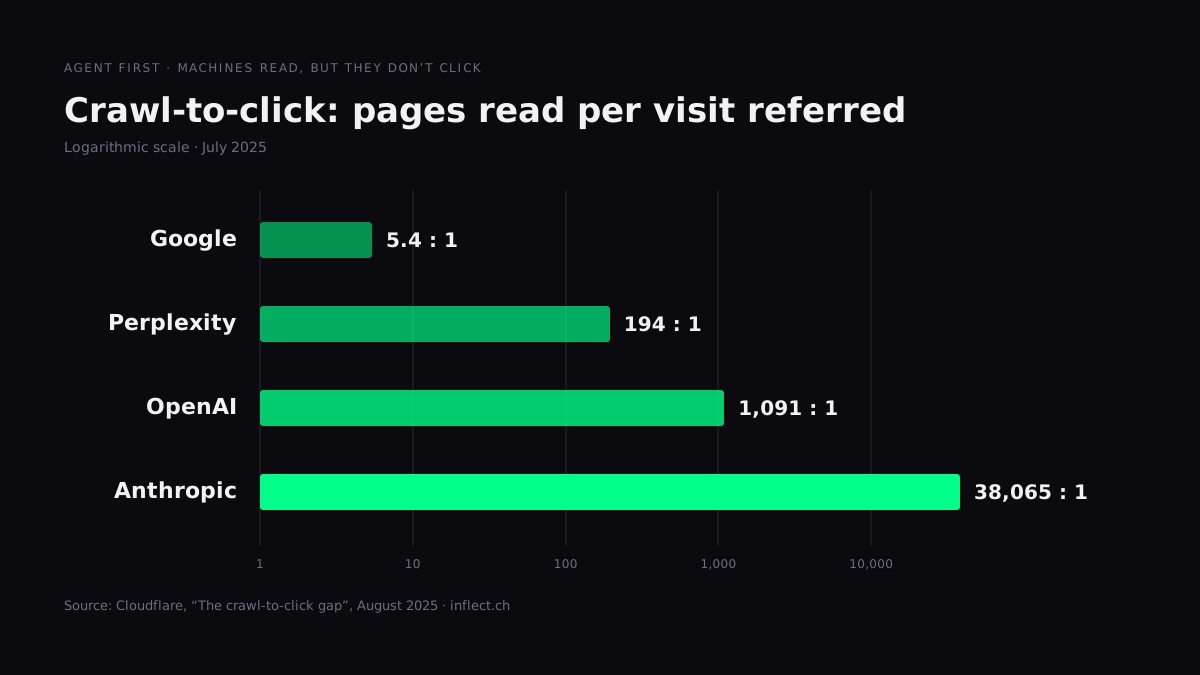
In other words: your content is already being consumed thousands of times over without anyone seeing your website. The answer is produced at the AI, not on your page.
And even where people still search themselves, the click is disappearing. The Pew Research Center analysed 68,879 Google searches by 900 US adults in March 2025: without an AI summary, users clicked a result in 15 % of searches; with an AI summary, in 8 %. Only 1 % clicked a source inside the AI answer. Ahrefs compared 300,000 keywords over two years in February 2026: the click-through rate of the top position fell by 58 % for searches with an AI Overview. And according to Similarweb (June 2026), 68 % of all Google searches now end without a single click.
We have worked through what this means for Swiss SMEs in our article on traffic loss from AI Overviews. The short version: the key marketing question is shifting from “How do I get the click?” to “How do I become part of the answer?”
The New Channel: Small, Fast, Valuable
It would be wrong to see only the loss. In parallel, a new channel is emerging that is small but growing steeply and converting above average.
Similarweb counted around 1.13 billion visits referred by AI platforms to websites in June 2025 – compared with 191 billion from Google search. A fraction, but with 357 % growth within a year. And the channel is diversifying: ChatGPT’s share of AI visits fell from 76 % to around 53 % between mid-2025 and mid-2026, while Gemini now holds around 27 %.
What matters is the quality of this traffic. Adobe Digital Insights analysed more than one trillion visits to US retail websites: in May 2026, AI traffic was up 138 % year on year, and AI visitors converted 54 % more often than other visitors. A year earlier they had converted worse – the gap has completely flipped. Revenue per visit was 53 % higher.
The reason is plausible: whoever arrives via an AI answer has already done the research. The AI compared, pre-sorted and recommended – the person arrives with a decision, not a question.
And there is one number showing that visibility in AI answers pays off directly: Seer Interactive analysed 5.47 million search queries from 53 brands up to February 2026. Organic click-through rate with an AI Overview was 2.36 % versus 3.82 % without. But brands cited inside the AI Overview achieved 120 % more clicks per impression. It is not the click that is dying – it is the uncited click.
Switzerland Is Ahead of Europe – Its Websites Are Not
For Switzerland, this development is not an observation from the US. On the user side, the country is further ahead than almost anywhere in Europe:
- According to the Federal Statistical Office (April 2026), 47 % of 16- to 74-year-olds used generative AI in 2025 – the European average is 33 %. Switzerland ranks third behind Norway and Denmark; among 16- to 24-year-olds the figure is 79 %.
- The IGEM Digimonitor 2026 (August 2026) measures 80 % AI usage in the Swiss population, double the 2024 figure. 77 % use the AI mode in classic search engines, 57 % search specifically via AI platforms. For shopping advice, AI platforms at 39 % are already level with YouTube.
- comparis found in March 2026: 41.6 % of Swiss people use AI chatbots instead of Google or Bing for web search.
- Google AI Mode has been available in Switzerland since October 2025 – in German, French and Italian.
On the website side, the picture is different. The Swiss Web Study 2026 analysed 1.46 million .ch websites: 25.2 % use structured data at all, but only 2.7 % use business-relevant types such as LocalBusiness or Offer – precisely the information an AI system needs to understand and recommend a company. The study’s conclusion: “The Swiss web is still insufficiently prepared for AI search.”
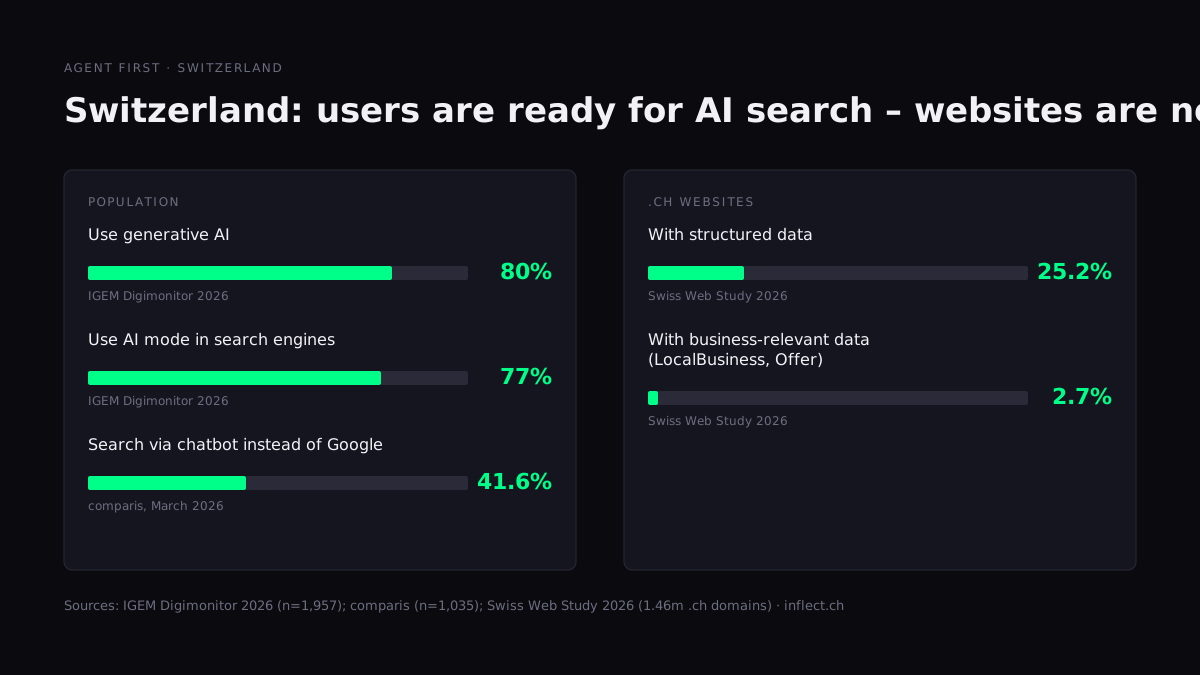
For businesses that act now, this gap is an opportunity. Swiss companies also need AI systems to understand them in several languages – something most websites have not yet solved cleanly.
What Agent First Really Means Today – and What It Doesn’t Yet
“Agent first” sounds like science fiction, but it is technically far advanced – and commercially still at the beginning. Both belong in an honest assessment.
Technically: OpenAI describes the ChatGPT agent (July 2025) as a system that works with its own virtual computer, navigates websites, filters results and, depending on the task, chooses between a visual browser, a text-based browser, a terminal and direct API access – to perform tasks as efficiently as possible. The infrastructure behind it is in place: the Model Context Protocol (MCP) counts more than 10,000 active public servers and was handed to the Linux Foundation at the end of 2025; Google’s Universal Commerce Protocol (January 2026) is backed by Shopify, Walmart, Zalando and Mastercard.
Commercially: direct purchase inside the chat is stalling. OpenAI launched “Instant Checkout” in ChatGPT in September 2025 – and discontinued the feature in March 2026 to focus, in its own words, on product discovery. Its own browser Atlas was also shut down in August 2026; the agent capabilities are moving back into ChatGPT.
This leads to a more precise thesis than “the agent will soon buy”: the agent makes the shortlist today. Research, comparison and pre-selection already happen by machine – the transaction, for now, mostly by a human. Whoever does not appear in the machine’s shortlist never reaches the human.
The willingness is there: according to Adyen (January 2026), 51 % of US consumers would let an AI handle the entire purchase including checkout. Gartner predicts that by 2028, 90 % of B2B buying will be intermediated by AI agents – a forecast, not a measurement, but one that procurement departments are already preparing for.
Two Audiences, Three Layers: SEO, GEO and Agent Readiness
If websites must work for humans and machines, SEO is no longer sufficient as a mental model. It is not being replaced either – it gains two additional layers:
- SEO asks: does Google find and rank my page? Crawlability, content, links, technology. The foundation remains – Google explicitly stresses that the same fundamentals apply to AI Overviews and AI Mode.
- Generative Engine Optimization (GEO) asks: does a generative system understand my business and use it as a source or recommendation? Clear entities, quotable statements, documented figures, consistent information across all channels. We have described the difference in detail in GEO vs. SEO.
- Agent readiness asks: can an agent not only understand my offer, but work with it? Prices, availability, service area, contact channels and actions so explicit that a machine can extract and compare them without interpretation.
A word on shortcuts: Google states literally in its guidance on AI features that no new machine-readable files, AI text files or special markup are needed to appear in AI features. The much-discussed llms.txt file confirms this: Ahrefs examined 137,000 domains in June 2026 – 97 % of existing llms.txt files were not fetched by a single bot during the observation month. An llms.txt does no harm and is quick to set up – but being machine-readable does not mean creating a file. It means the page itself is unambiguous.
And one decision that should not be left to chance: from September 2026, Cloudflare blocks training and agent crawlers by default on newly set up, ad-funded websites. Whoever does not consciously define which machines may do what may soon be locking out exactly the agents that are supposed to bring customers.
Agent Readiness Checklist for SMEs
The good news: most of this is not rocket science, but discipline. Sorted by impact:
- 1. Check crawlability – including CDN and bot rules. Whatever is blocked in robots.txt, at the host or in the firewall does not exist for AI systems. Decide deliberately which crawler categories (Search, Agent, Training) are allowed.
- 2. Important content as text, not as image or PDF. Prices in a graphic, services in a slider, opening hours in a PDF – invisible to machines.
- 3. Make the entity unambiguous. Company name, location, services, people and contact details identical everywhere – website, Google Business Profile, LinkedIn, directories. Contradictions lower the machine’s trust.
- 4. Structured data that matches the visible text. Organization, LocalBusiness, Service, Offer, FAQPage – Google explicitly requires markup and visible content to match.
- 5. Write to be quoted. The first 40 to 60 words of every section must stand without context: who, what, for whom, where. AI systems extract paragraphs, not pages.
- 6. State prices, availability and service area explicitly. “On request” is an exclusion criterion for an agent comparing three providers.
- 7. Provide original data and expertise. Your own figures, case studies, experience – content that exists nowhere else is the content that gets cited.
- 8. Measure. Since June 2026, Google Search Console shows separately how often a page appears in AI Overviews and AI Mode. Add server-log analysis for AI bots and regular checks of whether ChatGPT, Gemini and Perplexity mention the company for relevant questions.
How Generative Engine Optimization tackles these points systematically – from entity clarification to measurement – is described on our service page.
FAQ
What does agent first mean?
Agent first describes an internet in which AI agents – software that researches, compares and acts on behalf of a person – become an audience of websites in their own right. Websites must then be not only readable and usable for humans, but unambiguously extractable for machines: who offers what, where, on which terms.
How much web traffic comes from bots and AI today?
According to Imperva (2026), around 53 % of all web traffic in 2025 was automated, 47 % human. AI bots accounted for 4.2 % of all HTML requests in 2025 according to Cloudflare – almost as much as Googlebot at 4.5 %. AI-related traffic is growing 6.5 times faster than human traffic, according to Fastly.
Does GEO replace classic SEO?
No. Google stresses that the same fundamentals apply to AI Overviews and AI Mode as to classic search: crawlability, text content, internal links, structured data. GEO builds on this and ensures generative systems understand, cite and recommend a business. Agent readiness is the third layer: an agent must also be able to work with the offer.
Do I need an llms.txt file?
Not as a requirement, but yes as an add-on. Google does not use it, and an Ahrefs analysis of 137,000 domains (June 2026) shows that 97 % of existing llms.txt files were not fetched by any bot – for visibility in ChatGPT or AI Overviews it is not a lever. It makes sense as a low-cost extra, especially for documentation and software sites read by coding agents. We set it up as part of the technical basics – but what matters is making the website itself unambiguous: clear structure, text instead of images, consistent company data, correct schema markup.
Should I block AI crawlers?
That is a deliberate business decision, not a technical one. Blocking training crawlers protects content but risks not appearing in AI answers. Blocking agent and search crawlers makes you invisible to AI search and AI agents. From September 2026, Cloudflare blocks training and agent crawlers by default on new ad-funded websites – so check what your infrastructure allows today.
How do I measure whether AI systems use my website?
Three ways: since June 2026, Google Search Console reports impressions and clicks from AI Overviews and AI Mode separately. Server logs show which AI bots (GPTBot, ClaudeBot, PerplexityBot, ChatGPT-User) fetch which pages and how often. And regular spot checks with 20 to 30 industry-typical questions in ChatGPT, Gemini and Perplexity show whether and how the company is mentioned. Our free GEO/SEO check provides the baseline measurement.
Conclusion: Competition Is Moving from the Screen to the Decision Layer
The fight for digital visibility is not disappearing. It is relocating – from the human’s screen to the AI’s decision layer, where providers are compared and shortlisted before a person ever sees a website. The numbers are no longer forecasts: machines are the majority of traffic, AI systems read thousands of times more than they send back, and in Switzerland four in ten people already search via chatbot instead of Google.
That is why it is no longer enough for businesses to be visible on Google. Brand, expertise and offer must be understood, cited and recommended by generative systems – and processed by agents. That is exactly the core of Generative Engine Optimization. The simplest first step: our free GEO/SEO check shows you how your website looks to machines today – and which of the eight points above offer the biggest lever.
Further Reading
AI Overviews Cost 47% of Your Clicks — 7 Actions for SMEs
Fewer Google visitors in 2026? AI Overviews cut click rates by 47 percent. Seven Generative Engine Optimization actions for Swiss SMEs to fight back.
GEO vs. SEO: What Is the Difference and What Does Your SME Need?
GEO and SEO – two abbreviations, one goal: visibility. We explain the differences and why Swiss SMEs need both in 2026.
Google AI Mode Switzerland: What Changed for SMEs Since October 2025
Google AI Mode Switzerland has been live since October 2025. Five Generative Engine Optimization actions Swiss SMEs need to take now.
What Does GEO Deliver? The Competitive Edge for Early Movers
Generative Engine Optimization (GEO) decides who gets recommended in ChatGPT, Google AI & Perplexity. What GEO delivers – and why now is the right moment.
Ready to get started?
Let's find out together how we can move your business forward.